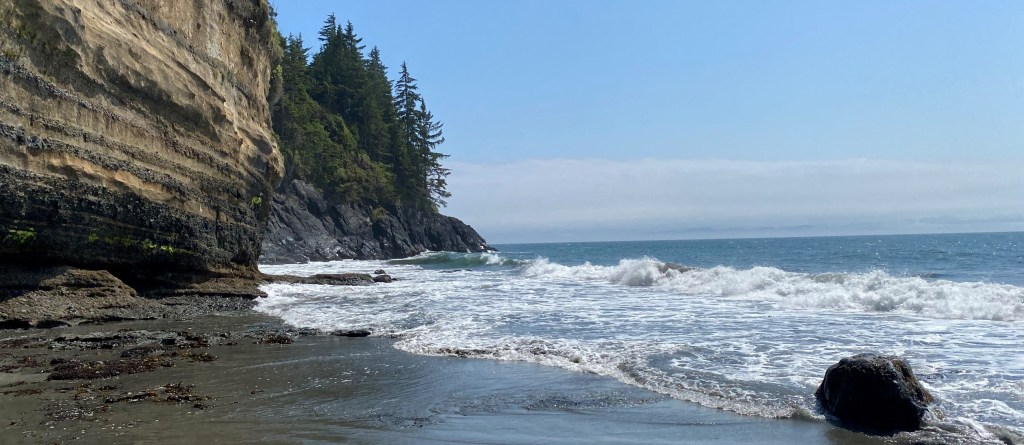
The primary focus of my research is to study how environment and species interactions influence population and community level processes across ecosystems. As a researcher, I have addressed this aim by developing a variety of field-based and quantitative approaches to study a wide array of systems (e.g., nearshore temperate reefs, estuarine habitats, and riparian areas).
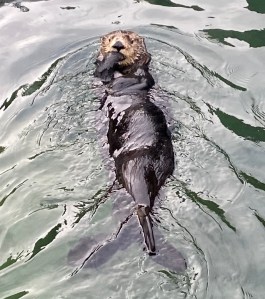
My current research is investigating the effects of sea otter (Enhydra lutris) recovery on nearshore ecosystems and Indigenous & commercial fisheries. My research is part of a large, collaborative project that includes natural scientists, social scientists, fisheries managers, and Indigenous knowledge-holders with the common goal of managing sea otter recovery inclusive of human communities. My contributions include: (1) Leading and developing a multi-state community model (i.e., Markov model) to show how sea otters affect transient and long-term community composition & dynamics in nearshore ecosystems. (2) Contributing to an invited submission synthesizing how Indigenous governance principles and traditional ecological knowledge can inform the study and management of biodiversity. (3) Leading a synthesis paper on the ecological and fisheries impacts of sea otter recovery across North America.
As a postdoc at the University of Washington and NOAA Fisheries, I examined how the structure of spatially explicit species distribution models affected model results and management decisions. Our findings showed that seemingly small choices, such as prediction scale, can impact estimates in species abundance and distribution, thus affecting management decisions. Additionally, I helped develop another project focused on incorporating non-stationary spatial variability into dynamic species distribution models. Our results demonstrated that our new approach led to more precise estimates to better inform management decisions.
As a PhD student at the University of North Carolina Wilmington, I developed and applied theoretical models to assess how disturbance frequency and intensity shape predator-prey dynamics. Using this theoretical framework and data that we gathered in the field, we developed an empirical model of eastern oysters (Crassostrea virginica) and one of their major predators to assess how disturbances (extreme salinity fluctuations) affected their interaction. Our theoretical model results revealed the potential for non-linear interactions between disturbance frequency and intensity and the effect on population persistence. Additionally, our two manuscripts in progress show that increasing salinity variability leads to lower extinction probabilities and higher population densities for oysters; and that effective management of oyster populations likely necessitates management of freshwater regimes as well as oyster predators.
PUBLICATIONS
Peer-Reviewed Articles
Ward EJ, Barnett LAK, Anderson SC, Commander CJC, Essington TE. 2022. Incorporating non-stationary spatial variability into dynamic species distribution models. ICES Journal of Marine Science, fsac179. https://doi.org/10.1093/icesjms/fsac179.
Commander CJC, Barnett LAK, Ward EJ, Anderson SC, Essington TE. 2022. The shadow model: how and why small choices in spatially explicit species distribution models affect predictions. PeerJ, 10:e12783. https://doi.org/10.7717/peerj.12783.
Commander CJC, White JW. 2020. Not all disturbances are created equal: disturbance magnitude affects predator–prey populations more than disturbance frequency. Editor’s Choice in Oikos, 129: 1-12. https://doi.org/10.1111/oik.06376.
Submitted Manuscripts
Salomon AK, Okamoto DK, Wilson KIBJ, Kobluk HM, Happynook T, Wickaninnish, Mack WTKA, Davidson SHA, Happynook TM, Lee LC, Tinker MT, Silver JJ, Armitage DR, McKechnie I, Hillis D, Muhl EK, Gregr EJ, Commander CJC, Augustine A. Measuring biodiversity for what and for whom: Diversifying values that shape biodiversity science and management. Invited Contribution: Philosophical Transactions of the Royal Society B: Biological Sciences Special Feature on Biodiversity, in review.
DeCourten BM, Poletto JB, Cocherell DE, Commander CJC, Cech Jr JJ, Fangue NA. Laboratory swimming performance of juvenile green sturgeon Acipenser medirostris and white sturgeon Acipenser transmontanus acclimated to different water velocities. Journal of Fish Biology, in revision.
Manuscripts In Preparation
Commander CJC, Tinker MT, Lee LC, Watson JC, Salomon AK, Gregr EJ, Bellis V, Yakujanaas J, Okamoto DK. Investigating the role of a keystone predator (the sea otter, Enhydra lutris) in driving spatial and temporal patterns of community diversity and dynamics in nearshore ecosystems. Target journal: Ecology Letters.
Commander CJC, Tinker MT, Lee LC, Okamoto DK. Examining the ecological and socio-economic impacts of sea otter recovery across coastal North America. Target journal: Nature Communications.
Commander CJC, Storch LS, White JW. Modeling the effects of extreme salinity disturbances on eastern oysters (Crassostrea virginica) and their major gastropod predator, the southern oyster drill (Stramonita haemastoma). Target journal: Marine Ecology Progress Series.
Commander CJC, Storch LS, White JW. Varying harvest levels and varying salinity disturbance regimes differentially affect eastern oyster (Crassostrea virginica) population persistence. Target journal: Canadian Journal of Fisheries and Aquatic Sciences.
 Christian Commander, PhD